When you click the OKX sign-in button you’re interacting with several overlapping systems: cryptographic authentication, regulatory identity checks, device-level protections, and the market-facing state of your positions. Those are different layers with different failure modes. Traders who treat “login” as a trivial step risk poor operational security, delayed withdrawals, or margin liquidation during volatile windows. This article unpacks the mechanism beneath the button, corrects common myths about KYC and custody, and gives decision-useful rules for US-based traders who want to move fast without exposing themselves to routine but avoidable risks.
Start with a simple reframing: “sign in” is an operational hinge, not just a gateway. It ties a human identity, a device, and a portfolio together. If any of those links is weak — a compromised phone, incomplete identity verification, or lax 2FA — the consequences are immediate and concrete: inability to trade options, frozen withdrawals while KYC is escalated, or loss from social-engineering attacks. Knowing the mechanism helps you prioritize where to harden your routine.
How OKX sign-in works (mechanics, not marketing)
At an operational level OKX sign-in combines three elements: credentials (email/password), device authentication (cookies, biometric tokens on mobile), and a second factor (2FA via SMS, authenticator app, or biometrics). For US users, the platform layers AI-driven anomaly detection: if a login deviates from historical device, IP, or behavioral patterns it will trigger additional challenges or temporary holds. That’s not arbitrary friction — it’s a risk decision: blocking a suspicious session early reduces the chance of large unauthorized withdrawals, but it also raises the chance of false positives that inconvenience legitimate traders.
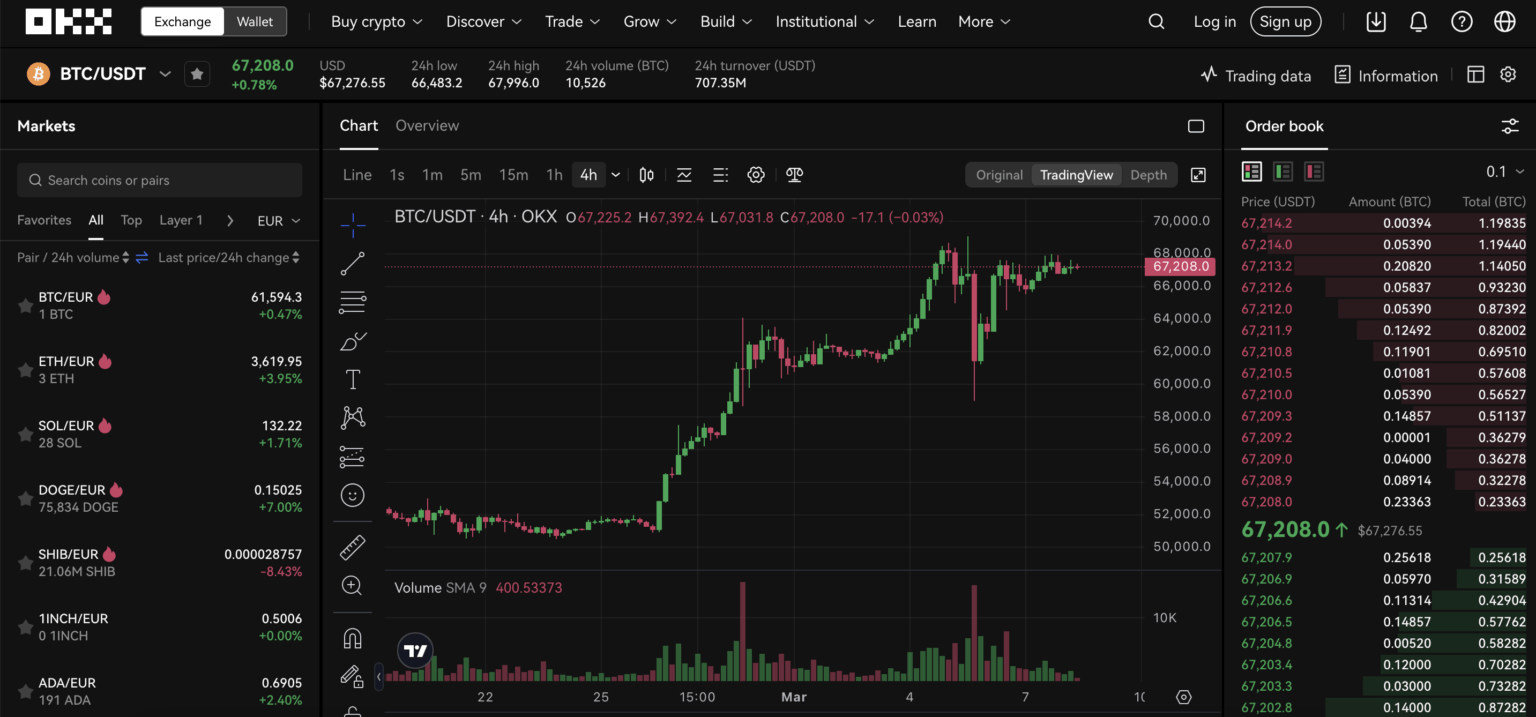
For traders who use the platform across desktop, mobile, and browser-extension contexts, session continuity matters. OKX’s web interface supports advanced TradingView charting that traders depend on, while the mobile apps support biometric login for convenience. Browser extensions provide Web3 connectivity for interacting with DEXs or the OKX wallet. Each surface has its own attack profile: mobile biometrics are convenient but depend on device security, browser extensions are powerful but magnify the risk from malicious sites or malicious extensions. Balance convenience against exposure.
Verification (KYC): what it does and what it doesn’t
Identity verification on OKX serves legal and operational functions: anti-money-laundering compliance, enabling fiat on-ramps and higher withdrawal limits, and, in practice, reducing friction when disputes or account recovery are necessary. The process in the OKX flow is a government ID submission plus a biometric liveness check — a step many US traders accept as standard but often misunderstand.
Myth-bust: KYC is not only about surveillance. For a trader it’s an access control mechanism: completed KYC unlocks product tiers (certain derivatives, higher margin) and faster fiat transfers. Conversely, incomplete or failed verification can freeze withdrawals or restrict access to futures trading. That delisting of several spot pairs this month is a reminder that the exchange actively manages its market surface — regulatory compliance and asset listings intersect with verification policies in ways that affect liquidity and tradability for specific tokens.
Custody trade-offs: centralized protections vs. self-custody reality
Many traders assume that keeping funds on an exchange is categorically unsafe. That’s too simple. OKX stores over 95% of assets in cold, air-gapped multi-signature wallets — an established industry control that reduces large-scale hot-wallet theft. They also publish Proof of Reserves, offering on-chain transparency about backing. Those are strong controls for counterparty risk.
But there are limits: cold storage reduces exchange-level hacking risk, not phishing or social-engineering risk at the user level. If an attacker controls your login or 2FA, they can abuse hot wallets and withdrawal processes before cold-storage safeguards matter. Likewise, non-custodial wallets offer ultimate control but put the user on the hook for seed phrase loss or smart-contract vulnerabilities when interacting with DeFi. Your choice is a trade-off between operational convenience and where you accept single points of failure.
Practical rules for US traders: a short operational playbook
1) Treat account verification as risk management. Complete KYC proactively if you rely on quick fiat on-ramps, margin trading, or futures. Late KYC during a market move often delays essential actions. 2) Harden login materials: unique, strong password; hardware-backed 2FA (preferably an authenticator app or a hardware key where supported); disable SMS if you can. 3) Separate custody by purpose: keep core capital in cold or self-custodial wallets and maintain a working balance on OKX sized for active strategies. 4) Use device compartmentalization: do your browser trading from a hardened machine and use mobile for monitoring and biometric quick checks. 5) Monitor OKX operational notices (e.g., routine delistings) because sudden liquidity changes affect execution, slippage, and margin models.
For a quick entry point to the sign-in page with guidance on device and verification preparation, you can reference OKX’s streamlined sign-in portal here: okx login.
Where this chain breaks — limitations, failure modes, and unresolved questions
Even with layered controls, three persistent limitations matter: 1) False-positive automated blocks. AI systems can lock legitimate users during critical trading moments; the alternative — looser detection — increases fraud. 2) Human recovery risk. If you lose access to 2FA devices or your KYC documents don’t match current IDs, recovery can take days, which matters if markets move fast. 3) Regulatory change risk. US regulatory signals could change acceptable verification requirements or product availability (for example derivatives access), which would alter the calculus for keeping certain positions on-exchange.
These are not speculative grievances: they are structural trade-offs between compliance, security, and convenience. The practical implication is a behavioral one: design your operational posture — how much you keep on-exchange, how you authenticate, and how you prepare documents — around how long you can tolerate operational downtime in a market event.
What to watch next (signals, not predictions)
Monitor three signal classes that will affect sign-in and verification friction: product surface changes (token delistings or new derivatives listings), regulatory actions or guidance in the US that change KYC scope, and platform security announcements (e.g., changes to 2FA, Proof of Reserves updates). Each can directly change how fast you can act. For example, routine delistings are a liquidity signal: if a token you hold is delisted, execution costs can spike — and quick access via an unencumbered sign-in and verified account will matter.
Conditionally, if regulatory pressure tightens, expect tighter verification gates and possibly staged access to leverage products. Conversely, if exchanges continue to demonstrate robust PoR and custody controls, platforms may be able to negotiate broader access with regulators, which could ease some frictions — but that remains an open question tied to policy dynamics rather than technical fixes.
FAQ
Q: If I complete KYC, does OKX still require 2FA every time I sign in?
A: Yes. KYC and 2FA address different risks. KYC links identity to an account; 2FA protects the session. Even verified accounts must pass device and second-factor checks. You can expect occasional re-verification when device fingerprints or IPs change.
Q: Can I use biometrics on my phone instead of Google Authenticator?
A: Biometric login on mobile is supported for convenience, but it’s layered on top of other factors. For critical operations (withdrawals, margin changes), the platform may still require a time-based authenticator or hardware 2FA. Biometrics are strong for local device access but don’t replace recovery-safe keys.
Q: If my account is flagged during sign-in, how long will it take to regain access?
A: That varies. Automated holds can resolve quickly if the system accepts the challenge responses; escalations requiring manual review or additional KYC evidence can take days. The exact time depends on workload, the nature of the flag, and whether you can promptly provide requested documents.
Final heuristic: think of sign-in and verification as throughput controls in a trading system. They are not nuisance steps — they determine whether you can execute under stress. Harden the weakest link you can fix quickly (2FA and device hygiene), complete KYC before you need it, and size your on-exchange exposure to what you can tolerate being operationally delayed from moving. That simple framing separates traders who survive volatility from those who become victims of timing and process friction.
